
Everything Wheelo does,
in five parts
This is the detailed list. If you'd rather see the shape of it first, the home page explains the problem and how it's solved, and How it works walks through setup in six steps.
The part that runs
every week without you.
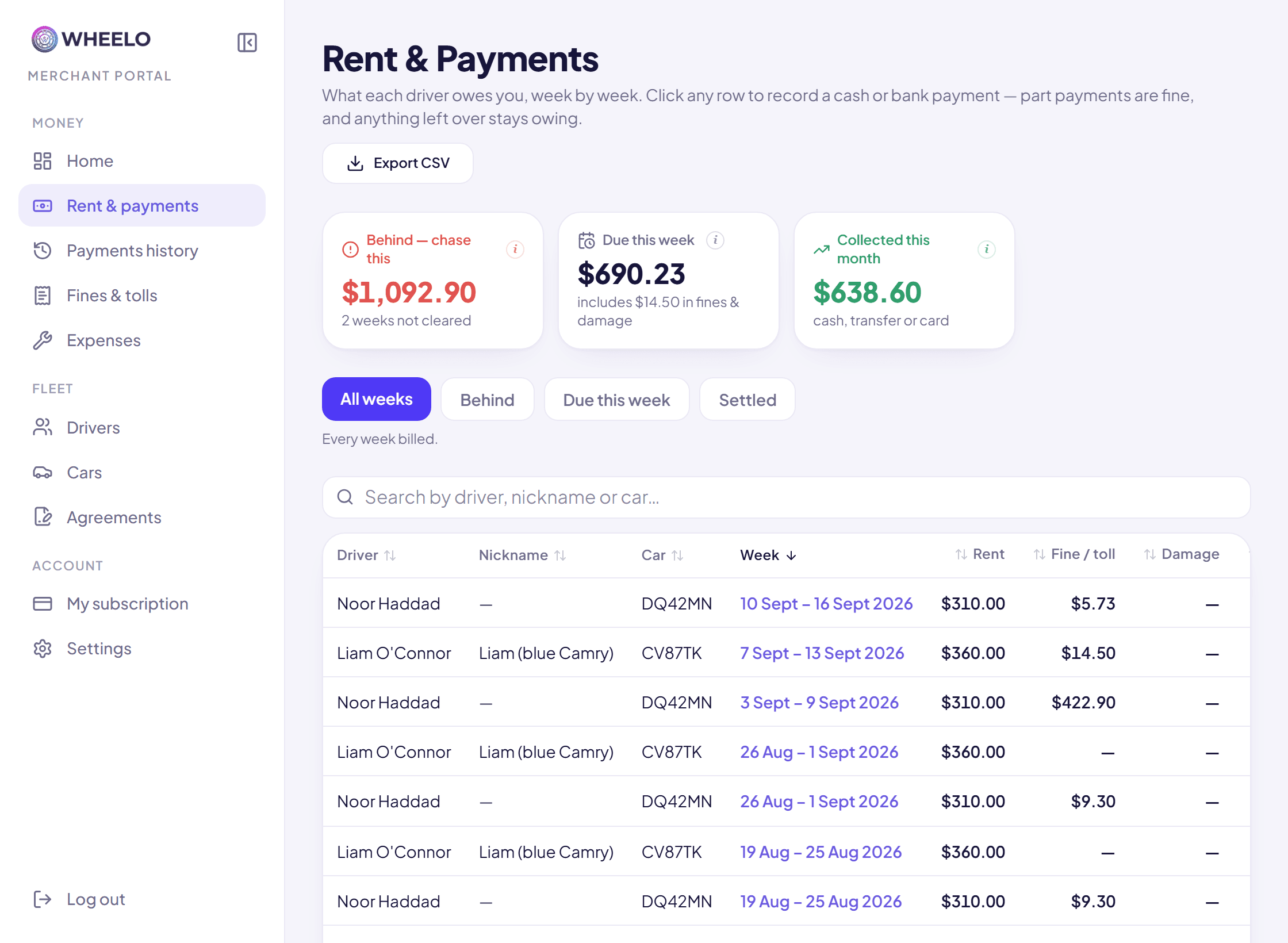
Rent is charged on each rental's own weekly cycle, the driver is warned the day before, and only the outstanding balance is ever taken. Everything below is what happens around that.
01 · Getting paid
Collection, and every way it can go sideways
The ordinary week is one line of this list. The rest is what happens when a card fails, a driver pays cash, or someone leaves owing money.
- Automatic weekly collection
- Charged the day after each rental's own week ends. A fleet's charges spread across the days rather than all landing on one.
- The day-before email
- Amount and date, every single time. Nothing is ever taken from a card without it.
- Only the balance
- Total, minus cash you recorded, minus anything you waived. Never the headline figure.
- Retries that know when to stop
- Next night, up to three attempts, then the week waits for you rather than hammering the card.
- Charge now
- When the driver says the money is in, collect on the spot — one click, any time.
- Cash and bank transfer
- Recorded against the same week, alongside card. Part payments are first-class: $200 of a $360 week leaves $160 owing, visibly.
- Waivers and write-offs
- Knock money off without rewriting the original bill. Written-off money is reported separately, so it never looks like money you collected.
- Pro-rata first and last weeks
- Billed by the day. A Wednesday start is four days, not seven — and the same at the end.
- Below-minimum handling
- A few cents left over is never attempted. It can't succeed, and three failures would wrongly mark a driver overdue.
- Bank debits held as clearing
- BECS, ACH, SEPA and Bacs show as pending, not paid, until they settle — that money can still bounce.
- Backlog catch-up
- A driver who finally adds a card is warned, then collected one week a night, oldest first. Never one large surprise charge.
- Live board and CSV export
- Behind, due, and collected split apart. Export the lot for your accountant.
02 · Agreements
Paperwork that still holds up a year later
The most expensive gap in a handshake business is not having a record of what was agreed. Signing takes a driver about a minute.
- Standard contract or your own
- Use Wheelo's template, or upload your own PDF and have drivers sign that instead.
- Signed on their phone
- They type their full name and tick the box. Time-stamped and IP-stamped.
- Frozen at the moment of signing
- The exact wording they saw is stored with a version number. Editing the template later changes what the next person signs — never theirs.
- Card authority is part of it
- Weekly charges are agreed up front, in the document, rather than assumed.
- Readable by both sides, forever
- The driver and the merchant can both re-open the signed copy at any time.
- Bonds recorded
- Held against the agreement, with the date it was taken.
- Notice, from either side
- Pick a last day and a reason. Rent runs to that day and no further, pro-rata.
- Debt survives the rental
- Ending an agreement is not a way to escape arrears. Unpaid weeks stay visible to both sides.
03 · Drivers
They do their own admin
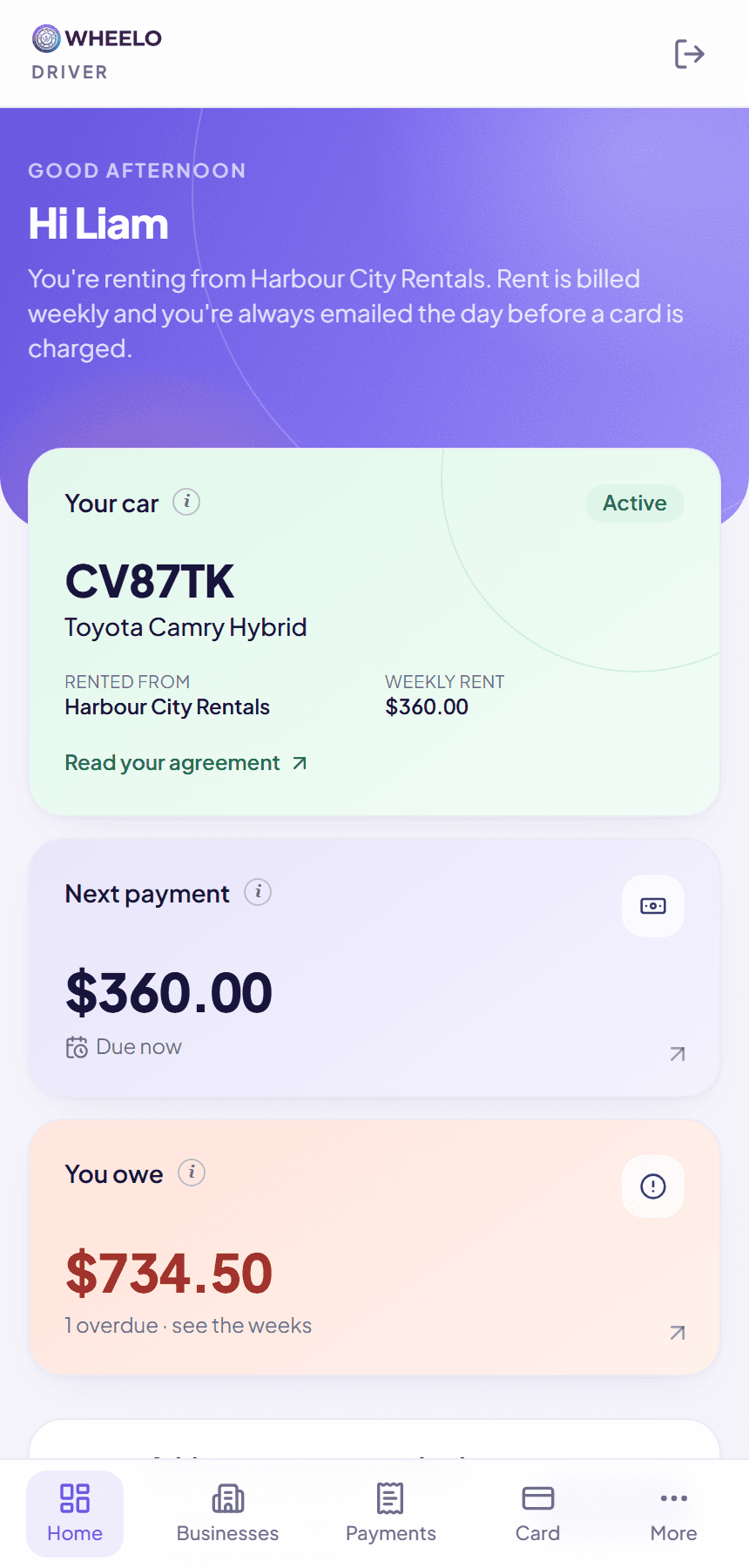
You send a link. They create the account, enter their own licence, sign, and add their own card. You never handle their paperwork or their card number.
- Invite by email
- Four situations handled automatically: brand new, already a Wheelo driver, already yours, or an email that's already a merchant account.
- They can decline
- With a reason, without logging in — and you're emailed, so you don't hold a car for someone who has said no.
- Their own details and licence
- Entered and uploaded by them, checked off on your setup list.
- Nicknames
- So two drivers with the same name never get mixed up.
- Card status at a glance
- Ready to charge, expired, or not added yet — colour-coded on your Drivers screen.
- Two businesses stay separate
- A driver renting from two merchants has two independent cards, queues and debts. Neither of you sees the other.
- Their own portal
- Works in their phone browser. Nothing to install.
- Leaving, cleanly
- Only when there's no live agreement and nothing owed. Their records stay on your books either way.
04 · Your fleet
Which car actually earns
Revenue on its own flatters a car. Rent collected against what it costs to keep on the road is the number that tells you whether to keep it.
- Cars with their paperwork
- Plate, make, model, and registration and insurance expiry dates.
- Reminders that arrive in time
- 30 days and 7 days before either expires. A car is never off the road for paperwork.
- Expenses per car
- Servicing, repairs and tyres, logged against the vehicle.
- Profit per car, not revenue
- Rent collected minus what it cost. The busy car that loses money stops being invisible.
- Fines matched to the minute
- Enter the plate and the date and time on the notice. Wheelo finds who held that car then and bills them.
- Unattributed fines flagged
- If the car was between drivers it's shown as yours to absorb, rather than billed to the wrong person.
- Idle cars surfaced
- Available and earning nothing, counted on your home screen.
- Return confirmation
- Only you can mark a car back — so one car can never be promised to two drivers.
05 · Money & safety
Where the cash sits, and who carries the risk
Wheelo is software, not a payment company. The money and the liability both stay with you and Stripe — we are never in the middle.
- Your own Stripe account
- Sign in with the account you already have. Rent settles there and pays out on your own schedule.
- 0% commission on rent
- Our revenue is the flat monthly subscription. Nothing is skimmed off what you collect.
- Card numbers never stored
- Cards are entered on Stripe's own pages. We keep a token, the brand and the last four digits.
- Every business isolated
- Enforced by database row-level security, not by what the interface happens to show.
- Twenty currencies
- AUD, USD, GBP, EUR, CAD and fifteen more. One per business, locked, so a ledger never silently changes meaning.
- Audit log
- Every payment, waiver, write-off and account action recorded with who and when.
- Email on every sensitive event
- Signing, notice, returns, charges, cash recorded, waivers — to whichever side needs to know.
- Disconnect protection
- Stripe can't be unhooked while live rentals still collect by card, because that would fail silently.